UV DEGRADATION
Standard polypropylene mats shred in direct sunlight within days. The fiber structure breaks down. The mat falls apart on the pad.


That was decades ago. The instrument became a company. The company built a product for every place oil meets earth — from West Texas wellheads to Gulf Coast refineries. The ground is still waiting for the same answer.
Every oil and gas facility in America that stores more than 1,320 gallons aboveground — and virtually all of them do — must maintain an SPCC plan under federal law. That plan must include provisions for spill prevention, containment, and cleanup. Absorbent mats are explicitly listed as spill response materials in EPA guidance.
The penalty for non-compliance: up to $27,500 per day. Per violation. And SPCC inspectors cite each deficiency separately.
How many zones at your facility have chronic drip points right now?
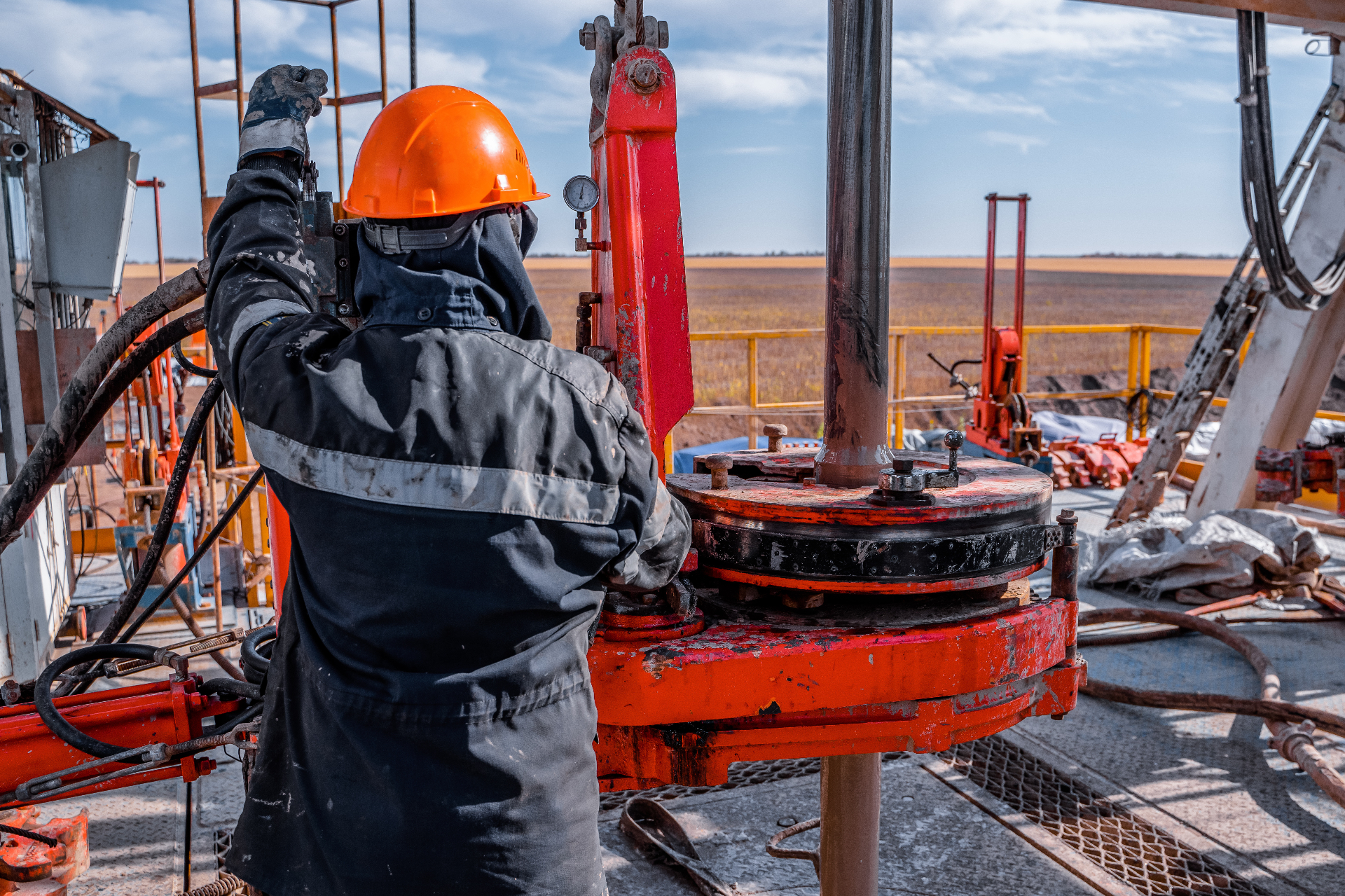
But regulation isn't the only problem. Oil and gas is an outdoor industry. And outdoor conditions destroy standard absorbent products.
Standard polypropylene mats shred in direct sunlight within days. The fiber structure breaks down. The mat falls apart on the pad.
Captured oil releases back into the environment during rain. The mat absorbed crude on Tuesday. Thursday's storm put it back on the ground.
Lightweight pads blow off the site. The mat under the wellhead is now 200 yards downwind in the brush.
The white pads that work inside a warehouse don't survive a week on a well pad in the Permian Basin.
And every producing state has its own rules. State enforcement is often more aggressive than federal.
| State | Agency | Reporting Threshold |
|---|---|---|
| Texas | Railroad Commission | >5 barrels or any reaching water |
| Oklahoma | Corporation Commission | Any spill or discharge |
| Pennsylvania | DEP | Any release to water, land, or air |
| North Dakota | Industrial Commission | Any discharge >1 barrel |
| Colorado | ECMC | Spill/release reporting required |
| California | CalGEM + RWQCB | Zero-discharge expectation |
The Exxon Valdez grounding in 1989 — 11 million gallons in Prince William Sound — revealed that neither industry nor government was prepared. Congress responded with the Oil Pollution Act of 1990, establishing strict liability and the Oil Spill Liability Trust Fund. The SPCC rule (40 CFR Part 112), originally from 1973, requires any facility storing more than 1,320 gallons aboveground to maintain a spill prevention plan certified by a Professional Engineer for larger facilities.
The Deepwater Horizon blowout in 2010 — 4.9 million barrels over 87 days, costing BP roughly $65 billion — triggered the breakup of the Minerals Management Service and doubled the offshore inspector workforce. Every significant tightening of oil spill regulation traces back to a disaster that proved the previous rules weren't enough.
Inspection rates are low — roughly 90% of sites in New Mexico's Permian Basin go uninspected in any given year. Violations are discovered through direct inspections, citizen complaints, aerial FLIR surveillance, satellite methane monitoring, and discrepancies in self-reported data. The enforcement progression: Notice of Violation → compliance order → consent decree (court-filed, 5-10 year duration).
Penalties have escalated dramatically. In FY 2024, EPA concluded 19 oil and gas enforcement cases imposing nearly $72 million in civil penalties. The landmark: Marathon Oil's $64.5 million penalty — the largest Clean Air Act stationary source penalty ever — for violations at nearly 90 facilities on the Fort Berthold Indian Reservation, plus $177 million in mandated compliance investments.
The Texas Railroad Commission — three elected commissioners accepting unlimited campaign contributions from the industry they regulate — is widely criticized for inadequate enforcement. At the opposite end, California's CalGEM enforces 3,200-foot setbacks from homes and a fracking phase-out. Colorado's ECMC changed its mission in 2019 from fostering oil and gas development to protecting public health, safety, welfare, the environment, and wildlife. New Mexico requires operators to capture 98% of natural gas by 2026.
So the question isn't should I do something about spill prevention. The question is what, exactly, goes where — in a facility that has seven different environments.
Answer 4 quick questions and get your top 3 absorbent mat matches — built for your industry, your spills, your environment.
This is the part nobody else shows you. HalenHardy makes one product for outdoors. New Pig makes one product for indoors. But an oil and gas facility isn't one environment — it's seven. And putting the wrong product in the wrong zone doesn't just waste money. It creates a new liability.
Click any zone. You'll see what works, why, and where it falls short.
Why: UV-resistant. Oil-selective — absorbs petroleum, lets rainwater evaporate. Impermeable bottom prevents oil from reaching soil. Berry Compliant.
Best when: Always for wellhead pads and pump jack bases. The defining application.
◇ 39-gallon capacity vs. HalenHardy's 135 gal. Capacity gap matters when mats sit for weeks between service visits.
Why: Precision pads at specific drip points — packing glands, valve stems, gauge connections. Quick deployment during well service. Berry Compliant.
Best when: Targeted drip management at specific connection points. During workover or completion operations.
◇ NOT outdoor-rated for extended exposure. No UV protection. For short-term service operations, not long-term placement.
Why: Barrier backing for areas where oil absolutely cannot reach soil. Berry Compliant.
Best when: Sites with heightened sensitivity — near waterways, wetlands, wellhead protection zones.
◇ NOT UV-rated for full outdoor exposure. Not oil-selective — absorbs water too.
Before we show you comparison tables, here's something most companies wouldn't tell you. So why are we showing you this? Because an oil and gas facility isn't one zone. It's seven. And HalenHardy makes one product. We'll show you who wins where — including where we don't.
Five competitive arenas. Full specs. Honest reads. Click any category.
| Product | Size | Capacity | Price | $/Gallon | UV Rating | Oil-Selective | Berry |
|---|---|---|---|---|---|---|---|
| SupAbsorb W-281 | 58"×80' | 39 gal | $329 | $8.44 | Black PP geotextile | Yes | Yes ✓ |
| HalenHardy SPL122 | 52"×100' | 134.9 gal ✓ | $576 | $4.27 ✓ | 2-yr guarantee ✓ | Yes | No |
| SpillTech TMAT57 | 57"×80' | 63 gal | $262 ✓ | $4.16 ✓ | Not published | Standard PP | No |
| Spilfyter M-151 | 58"×80' | 96 gal | $326-435 | $3.40-4.53 | Not published | Standard PP | No |
| New Pig MAT465 | 59"×100' | 60 gal | ~$400-600 | $6.67-10.00 | 12 mo | Standard PP | No |
| Brady SPC TM58 | 58" wide | — | ~$200-400 | — | Not published | Standard PP | No |
The pattern across all five arenas: HalenHardy wins the outdoor comparison. SupAbsorb wins everything else. And everything else is five of seven zones in an oil and gas facility.
Every product on this page is made in America. Five of six lines are Berry Compliant. Up to 90% recycled content.
You don't need to solve every wellhead, every compressor building, and every loading rack today. Pick the zone that keeps you up at night.
$5 sample of any product. See how it performs in your field conditions — UV, rain, wind. Then decide.
Order SamplePick your worst zone. One roll of the right product. Let it sit for a month in your conditions. The mat speaks for itself.
Shop NowHave questions about which products fit your facility? Schedule a call to discuss your needs. No pressure. No obligation.
Schedule a Call"The ground remembers what you spill on it."
"And what you prevent."